ARP on the International Stage: The First Year’s Achievements and Breakthroughs
The HUN-REN ARP (Research Data Repository Platform) officially opened its “data gates” to HUN-REN researchers on 25 November 2024. With this, the platform’s first development phase was completed. In 2025, the development team of HUN-REN SZTAKI DSD (Department of Distributed Systems) focused not only on system operation and bug fixing, but also on presenting ARP’s innovations to the international professional community.
Our goal was twofold: to showcase the Hungarian ARP developments and to obtain direct professional feedback on how these innovations align with the cutting-edge global trends in research data management and storage. We regard it as a priority to ensure that ARP’s long-term vision remains in line with worldwide developments.
ARP × Dataverse: CEDAR Integration Attracting Interest from Harvard and Stanford
A major milestone in ARP’s international dissemination was the 2025 Dataverse Community Meeting organized by Harvard, held in Chapel Hill, North Carolina.
This invitation was preceded by a presentation during the January Dataverse Community Call, where a CoS (Center for Open Science) staff member demonstrated how CEDAR schema templates are used in OSF (Open Science Framework). At this meeting, we gave an ad hoc demonstration of the deep integration between ARP and CEDAR.
The presentation received unexpectedly enthusiastic feedback, and the Harvard Dataverse developers considered it important enough to invite us to present these developments at the upcoming Dataverse Community Meeting in Chapel Hill. There, we demonstrated how the integration of the CEDAR schema registry, combined with RO-Crate–based export, import and editing capabilities introduced into Dataverse—with our AROMA RO-Crate editor—enables significantly more detailed and efficient metadata annotation, making the creation of FAIR data packages significantly easier.
During our visit to the United States, the CEDAR development team at Stanford also invited Balázs Pataki, the lead of the Dataverse–CEDAR integration project, to give a presentation on how this integration was implemented within Dataverse, and what additional enhancements we introduced in CEDAR to support more efficient metadata schema creation and sharing, especially focusing on schema versioning.
These innovations are currently available only in ARP’s own Dataverse and CEDAR versions. Following the presentations and discussions, the Harvard Dataverse developers asked us to contribute these CEDAR and RO-Crate integration features to the core Dataverse codebase so that they can be included in a future official release. This will make our developments directly available to all Dataverse installations and users worldwide.
ARP × RO-Crate: Active Contribution to the Development of the RO-Crate Specification
A key element of ARP’s development vision is semantic-level data packaging and management with RO-Crate, which has become one of the most widely accepted research data packaging standards. RO-Crate is increasingly used in research data workflow engines, ELNs (Electronic Lab Notebooks), and numerous EOSC services.
The ARP’s choice to adopt RO-Crate has proven fruitful in light of the emerging European FDO (Fair Data Objects) initiative, which aims to enable machine-assisted discovery and automatic processing of data objects.
The FAIR initiative (“Findable, Accessible, Interoperable, Reusable”) aims to ensure that data objects are not only human-readable but also interpretable by machine agents. FDO provides exactly this capability. The FAIR Signposting approach already implemented in Dataverse, combined with our RO-Crate representation and extended schema/profile capabilities, positions ARP among the first systems worldwide to become FDO-compatible.
Given RO-Crate’s central role in ARP’s vision, we actively contribute to the work of the RO-Crate community and the development of its international specification. We are listed as authors on version 1.2. Our developments—including the AROMA editor—have been presented within the community; AROMA is prominently featured on the RO-Crate community website, and a dedicated blog post reports on ARP’s achievements.
In 2026, we plan to take an active role in standardizing RO-Crate profiles—an area where ARP already has more hands-on experience than many international partners.
ARP × AI: First Steps of the VibeARP Data Steward Assistant
Our work with RO-Crate, RO-Crate profiles, metadata schemas, and FDO compliance has led to a new demonstrable result. At the full-day HUN-REN ARP 2025 conference, we unveiled VibeARP, an experimental AI agent designed to make the metadata annotation of data packages faster and easier while maintaining high quality and completeness.
This experiment may ignite a process similar to the evolution of coding assistants: it could lead to the emergence of a data-steward assistant within ARP, reducing the mechanical workload for data stewards and researchers alike, and simplifying the onboarding process for users who do not wish to engage with the full functional complexity of ARP.
We successfully presented VibeARP at the October RO-Crate meeting, and again at the November Dataverse Community Call.
ARP × EOSC: Preparing for the Creation of a Hungarian EOSC Node
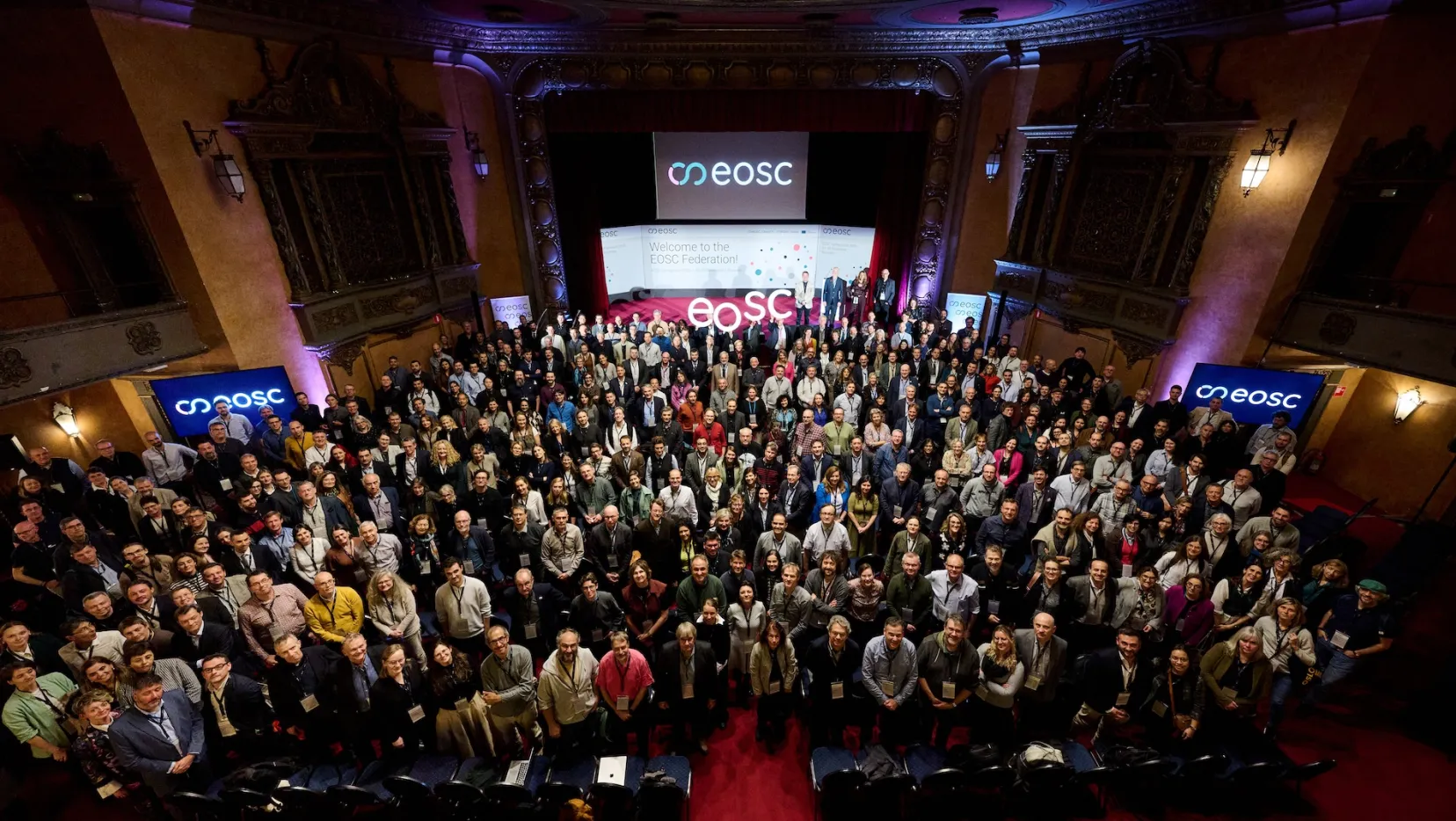
As in previous years, the HUN-REN SZTAKI DSD team developing ARP participated with a small delegation in the 2025 EOSC Symposium.
Our goal was to learn about the operation of the EOSC EU Node and the first national and thematic nodes, and to explore how Hungary—through HUN-REN ARP and HUN-REN Cloud—could connect to this ecosystem.
We found that although a national federation of Hungarian research infrastructures has yet to be established, ARP’s and Cloud’s current and planned developments are functionally world-class on the European level. Due to inherent limitations in scale and capacity, however, we do not yet match the size of similar European infrastructures.
Throughout the professional discussions, we repeatedly received feedback that ARP is significantly ahead in many respects. There was substantial interest in our CEDAR-based metadata schema registry and its integration, our RO-Crate and RO-Crate profile solutions, as well as the VibeARP project presented in informal conversations. These confirmed that our progress toward “AI for FAIR”—one of the highlighted themes of the symposium—is on the right track.
Our ultimate goal within EOSC is the establishment of a Hungarian national EOSC node, enabling connection between Hungarian and European research infrastructures. Although this remains a long-term objective, HUN-REN SZTAKI DSD staff already participate in several EOSC working groups.
– András Micsik: EOSC Technical and Semantic Interoperability Task Force
– Balázs Pataki: EOSC FAIR Metrics and Digital Objects Task Force
– László Kovács: OA2: Metadata, Ontologies and Interoperability, contributing to EOSC-related policy development.
Within the Technical and Semantic Interoperability Task Force, we were among the first to present ARP’s achievements in metadata schema and metadata interoperability—covering schema creation, application, use in RO-Crate data packages, and integration into the federated Hungarian research data repository network’s unified search interface, implemented through the coordinated operation of multiple ARP components.
ARP × Future: This Is Only the Beginning
Our participation in various professional events and communities, along with our presentations, confirmed that ARP’s current achievements and service portfolio are technically and scientifically at the forefront in many respects. At the same time, the directions in which we must take larger and more decisive steps are also clear if we are to gain a foothold—and maintain it—in major European research infrastructures via EOSC.
